


[Discussion Points] National Local Government Conference “Reflecting on Involvement of People with Lived Experience in Prefectural Healthcare Planning Processes to Promote Meaningful Involvement in Prefectures and Municipalities” (July 22, 2025)
date : 10/14/2025

![[Discussion Points] National Local Government Conference “Reflecting on Involvement of People with Lived Experience in Prefectural Healthcare Planning Processes to Promote Meaningful Involvement in Prefectures and Municipalities” (July 22, 2025)](https://hgpi.org/en/wp-content/uploads/sites/2/mip-ncd-20250722-top_ENG.png)
Health and Global Policy Institute (HGPI) formulated “Reflecting on Involvement of People with Lived Experience in Prefectural Healthcare Planning Processes – To Promote Meaningful Involvement in Prefectures and Municipalities.”
To promote meaningful involvement of people with lived experience, such as patients, people living with health conditions, their families and carers, service users, and other members of the public, in prefectures and municipalities, HGPI organized a national conference for local governments on November 11th 2024.
These Discussion Points summarize the challenges surrounding the involvement of people with lived experience, such as patients and other stakeholders, in local government policymaking processes, based on discussions held by experts, specialists, and local governments who participated in the conference. They also outline the necessary actions required to address these challenges. In addition, the document compiles numerous concrete initiatives and best practices from prefectures and municipalities across Japan. For details, please view the PDF provided bottom.
Discussion Point 1: Ensuring fair selection of patient advocate committee members for involvement in in government committees
1-1. Establishing appropriate terms of appointment for committee members according to circumstances in the region or disease area
1-2. Adopting flexible appointment methods to ensure patient advocate committee members are well suited to the purpose of the government committeeExample 1: Taking diversity in diseases, age groups, etc. into account when appointing multiple committee members
Example 2: Inviting committee members from other regions
Example 3: Adopting a broader range of conditions for people to be defined as “patients” or “affected parties”1-3. Publicly presenting information regarding the appointment process and requirements for patient advocate committee members in advance and ensuring fair appointments
Discussion Point 2: Methods of operating government committees that facilitate discussion participation for patient advocate committee members
2-1. Providing sufficient pre and post meeting explanations and follow ups
Example 1: Providing explanations tailored to the needs of individual patient advocate committee members in advance
Example 2: Providing psychological support after meetings2-2. Operating government committee meetings so patient advocate committee members can participate in discussions and offer comments more easily
Discussion Point 3: Utilizing various methods to collect and aggregate opinions from a vast range of people with lived experience of health concerns
3-1. Establishing government committees centered on people with lived experience
Example 1: Securing participation opportunities through opinion exchange sessions
3-2. Making effective use of hearings, surveys, and public comments
Discussion Point 4: Building cooperative and collaborative relationships with a wide range of people with lived experience of health concerns
4-1. Providing information in a thorough manner and devising methods of disseminating information tailored to its main target audience
Example 1: The effects and efforts of gathering public comments as an integrated part of Medical Care Plans
4-2. Using a variety of procedures and related initiatives to build cooperative relationships with a wide range of people with lived experience
Example 1: Using a peer supporter training program to recruit patient advocate committee members
4-3. Engaging in multi stakeholder collaboration to educate people with lived experience and to establish a social infrastructure that supports meaningful involvement
Example 1: Collaborating with multi stakeholders to encourage meaningful involvement
Example 2: Identifying and visualizing necessary personal qualities for meaningful involvement
![[Discussion Points] National Local Government Conference “Reflecting on Involvement of People with Lived Experience in Prefectural Healthcare Planning Processes to Promote Meaningful Involvement in Prefectures and Municipalities”](/assets/img/katsudo/icon_pdf_l.png)
Related Posts
-
2024-12-25
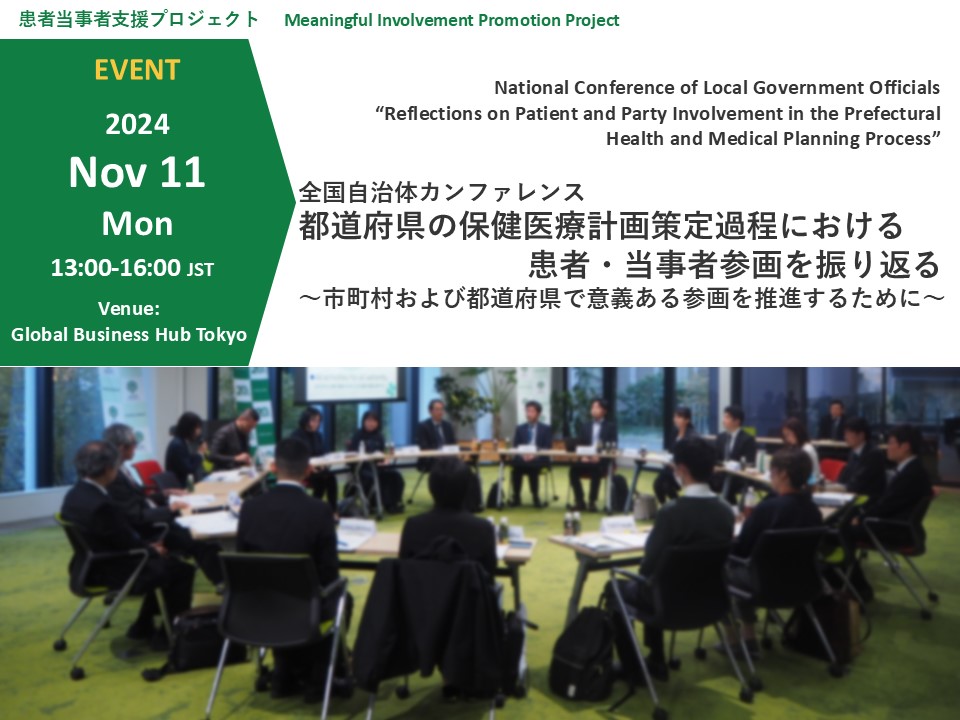
[Event Report] National Local Government Conference "Reflecting on Involvement of People with Lived Experience in Prefectural Healthcare Planning Processes - To Promote Meaningful Involvement in Prefectures and Municipalities" (November 11, 2024)
-

2024-12-01
[Activity Report] Announcing the Launch of the Japan’s Patient Expert Platform (J-PEP) Website (December 1, 2024)
-
2024-11-21
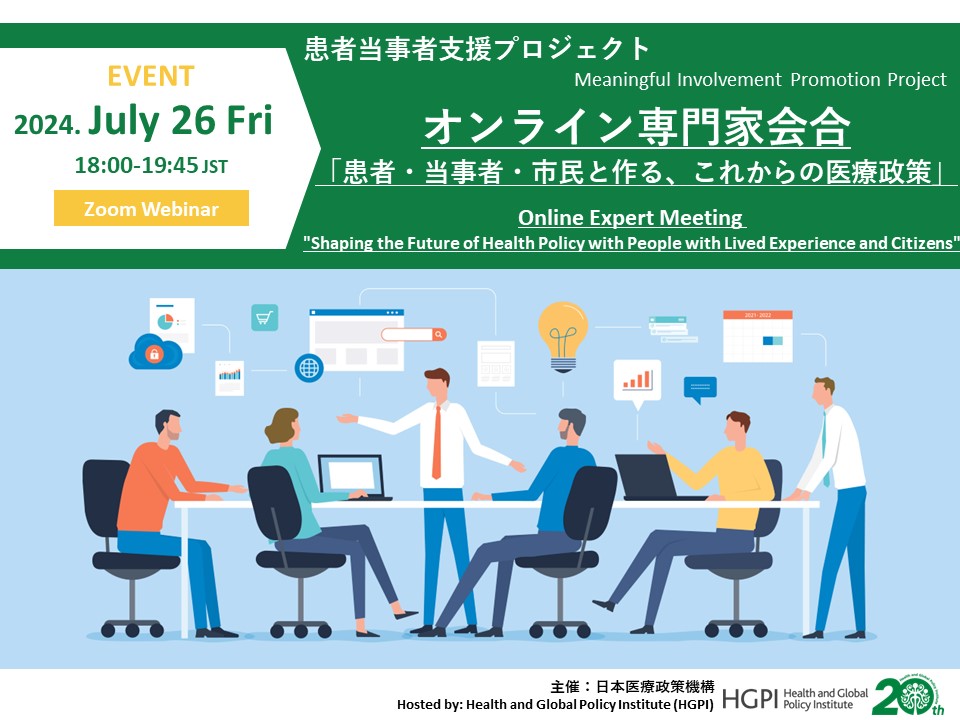
[Event Report] Meaningful Involvement Promotion Project Online Expert Meeting "Shaping the Future of Health Policy with People with Lived Experience and Citizens” (July 26, 2024)
-
2025-08-13
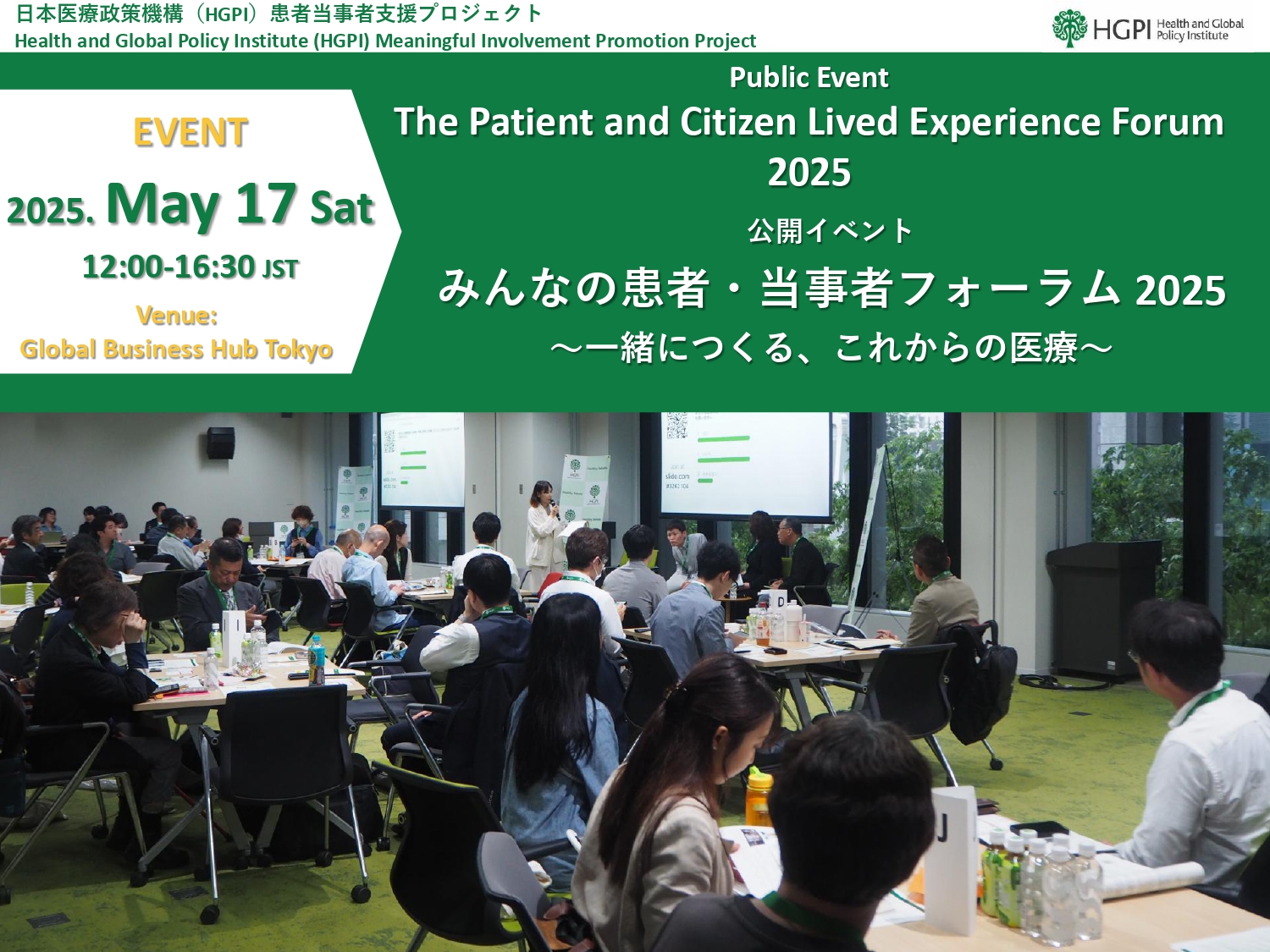
[Event Report] Public Event “The Patient and Citizen Lived Experience Forum 2025” (May 17, 2025)
-
2024-05-15
[Policy Recommendations] Patient and Public Involvement (PPI) Support Project “Promoting PPI in the Policymaking Process” (May 14, 2024)
-
2024-06-18
[Publication Report] Guidance on Patient and Public Involvement (PPI) in Health Policymaking: Necessary Initiatives and Good Examples from the Public and Government (March 31, 2024)
-
2024-09-27
[HGPI Policy Column] (No. 48) From the Meaningful Involvement Promotion Project: The Resolution on Social Participation at the 77th World Health Assembly
Top Research & Recommendations Posts
- [Research Report] Perceptions, Knowledge, Actions and Perspectives of Healthcare Organizations in Japan in Relation to Climate Change and Health: A Cross-Sectional Study (November 13, 2025)
- [Research Report] The 2025 Public Opinion Survey on Healthcare in Japan (March 17, 2025)
- [Policy Recommendations] Developing a National Health and Climate Strategy for Japan (June 26, 2024)
- [Research Report] The 2023 Public Opinion Survey on Satisfaction in Healthcare in Japan and Healthcare Applications of Generative AI (January 11, 2024)
- [Research Report] Survey of Japanese Nursing Professionals Regarding Climate Change and Health (Final Version) (November 14, 2024)
- [Policy Recommendations] Mental Health Project: Recommendations on Three Issues in the Area of Mental Health (July 4, 2025)
- [Policy Recommendations] Reshaping Japan’s Immunization Policy for Life Course Coverage and Vaccine Equity: Challenges and Prospects for an Era of Prevention and Health Promotion (April 25, 2025)
- [Publication Report] Planetary Health Promotion Project “Issues Facing Planetary Health and the Role of the Health Sector” (May 10, 2023)
- [Research Report] Survey of Japanese Physicians Regarding Climate Change and Health (December 3, 2023)
- [Announcement] HGPI Joins Global Green and Healthy Hospitals (August 1, 2023)
Featured Posts
-
2025-11-13
[Registration Open] (Webinar) The 1st J-PEP Seminar – Initiating Policy Advocacy from Meaningful Involvement (December 8, 2025)
![[Registration Open] (Webinar) The 1st J-PEP Seminar – Initiating Policy Advocacy from Meaningful Involvement (December 8, 2025)](https://hgpi.org/en/wp-content/uploads/sites/2/mip-ncd-20251208-top.png)
-
2025-12-01
[Policy Recommendations] Recommendations on Strategic Investments in Policies for Brain Health to Revitalize Japan: Hopes for the New Administration (December 1, 2025)
![[Policy Recommendations] Recommendations on Strategic Investments in Policies for Brain Health to Revitalize Japan: Hopes for the New Administration (December 1, 2025)](https://hgpi.org/en/wp-content/uploads/sites/2/HGPI_20251201_Recommendations-on-Strategic-Investments-in-Policies-for-Brain-Health.png)
